Batch Traceability Without a Full-Time Data Person
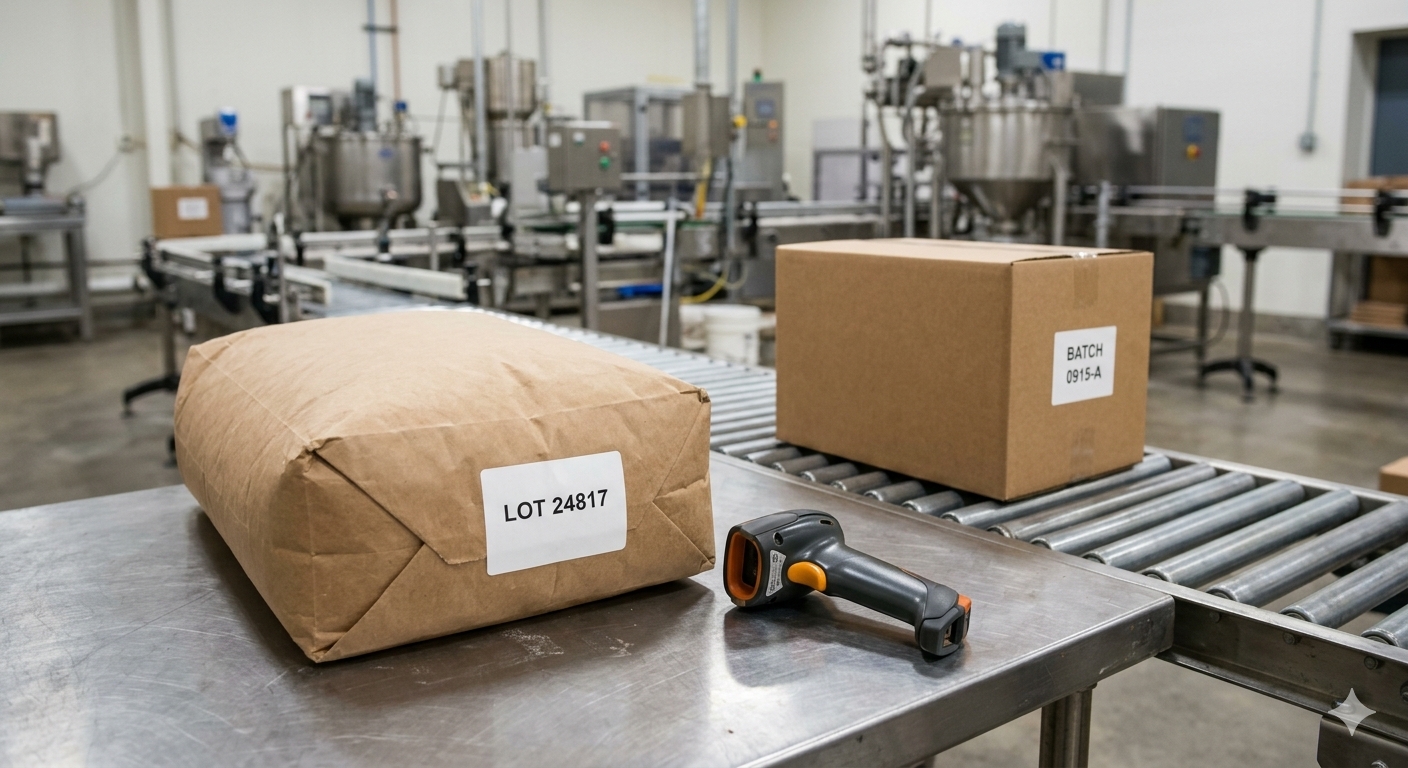
Trace requests never arrive at a good time. A customer complaint comes in late on a Friday, or an auditor picks a finished batch at random and asks you to show them every ingredient lot that went into it and every customer it went out to. In a lot of mid-size plants, the honest answer to "how long will that take?" is "depends whether Sharon's in today."
That's not a criticism of Sharon. It's usually the opposite. Somewhere in most plants there's one person, often in QA, who knows which folder, which spreadsheet and which shelf of paper records holds the answer. The business has quietly turned that person into its traceability system.
1. What traceability actually has to answer
Strip it back and traceability comes down to two questions. For any finished batch: what went into it, meaning which raw material and packaging lots, from which suppliers. And where did it go, meaning which customers received it and when.
Behind those two sits a third question that matters just as much in an audit: what happened while it was being made. The checks that were done, who did them, and whether anything was out of spec. A trace that can tell you the ingredients but not whether the metal detector check was done on that shift is only half a trace.
2. The holiday test
Here's a simple way to find out whether you have a traceability system or a traceability person. Imagine your QA lead is on two weeks' leave, with no phone reception, and a trace request lands. Could someone else on site complete it, accurately, in a few hours?
If the answer is no, or "probably, but it'd be ugly," then your traceability lives in someone's head. That's a risk the business is carrying whether anyone has written it down or not.
3. Where the chain usually breaks
The chain rarely breaks in the middle of a trace. It breaks at the point the data was supposed to be captured, often weeks earlier. The usual suspects:
- Lot numbers not recorded at goods-in, or written on a delivery docket that gets filed somewhere else
- A raw material lot that runs across two or three production batches, with nobody noting where one ended and the next began
- Rework added back into a batch with no record of where it came from
- Handwritten batch codes that are hard to read three months later
- A spreadsheet that got saved over, sorted wrong, or copied into a new version for the new financial year None of these are dramatic failures. They're small gaps that only show up when you need the chain to be complete.
4. Capture it where it happens, not afterwards
The fix isn't hiring someone to chase paperwork full time. It's capturing the link at the moment it happens, by the person who's there. The lot number gets scanned at goods-in. The raw material lot gets recorded against the batch when it's added at the line, not reconstructed at the end of the week. The checks get recorded against the same batch as they're done.
When the links are made at the source, a trace stops being an investigation. It becomes a lookup. That's the thinking behind how batch traceability works in Nexshift: lots, production and quality checks recorded in one place as the shift runs, so pulling a full trace forwards or backwards doesn't need a specialist.
5. Run a mock recall before someone forces you to
Most certification schemes will ask you to demonstrate a trace anyway, but don't wait for the audit. Pick a finished batch at random and time how long it takes to trace it back to raw materials and forward to customers. Then do it again with someone other than your usual person running it.
Write down every point where you got stuck, had to ask someone, or had to guess. That list is your actual traceability gap, and it's far more useful than any procedure document that says the process works.
6. What good looks like
Good traceability isn't fancy. It means any trained person on shift can run a trace, the answer comes back in minutes rather than a day of digging, and the record includes the checks done during production, not just the ingredients. It also means your QA lead can take a holiday without the business holding its breath.
Further reading
Traceability gaps are usually a symptom of a bigger problem: production, quality and dispatch data living in separate places that don't talk to each other. I've written about what that fragmentation costs day to day in One Shift, Five Systems, Zero Answers.