From Wonderware to Whiteboards: Building a Baseline From Nothing
For most of my early career, I never had to think about where the data came from. It was just there.
What a big plant gives you without asking
At Goodman Fielder, and later at Campbell Arnott's, the plants I worked in ran on proper MRP systems with Wonderware sitting across the floor pulling live data straight off the equipment. Production counts, downtime, cycle times, all of it captured automatically, all of it sitting in a dashboard by the time I walked into the morning meeting. I didn't build that. I inherited it. It was just the water I swam in, and like most people in that position, I didn't fully appreciate it until it was gone.
If I wanted to know how a line performed last month compared to the month before, the answer was a few clicks away. If I wanted to compare shifts, or products, or spot a slow drift in performance before it became a real problem, the data was already there waiting to be asked the question. I took that for granted in a way I'm slightly embarrassed about now.
Then I moved somewhere smaller
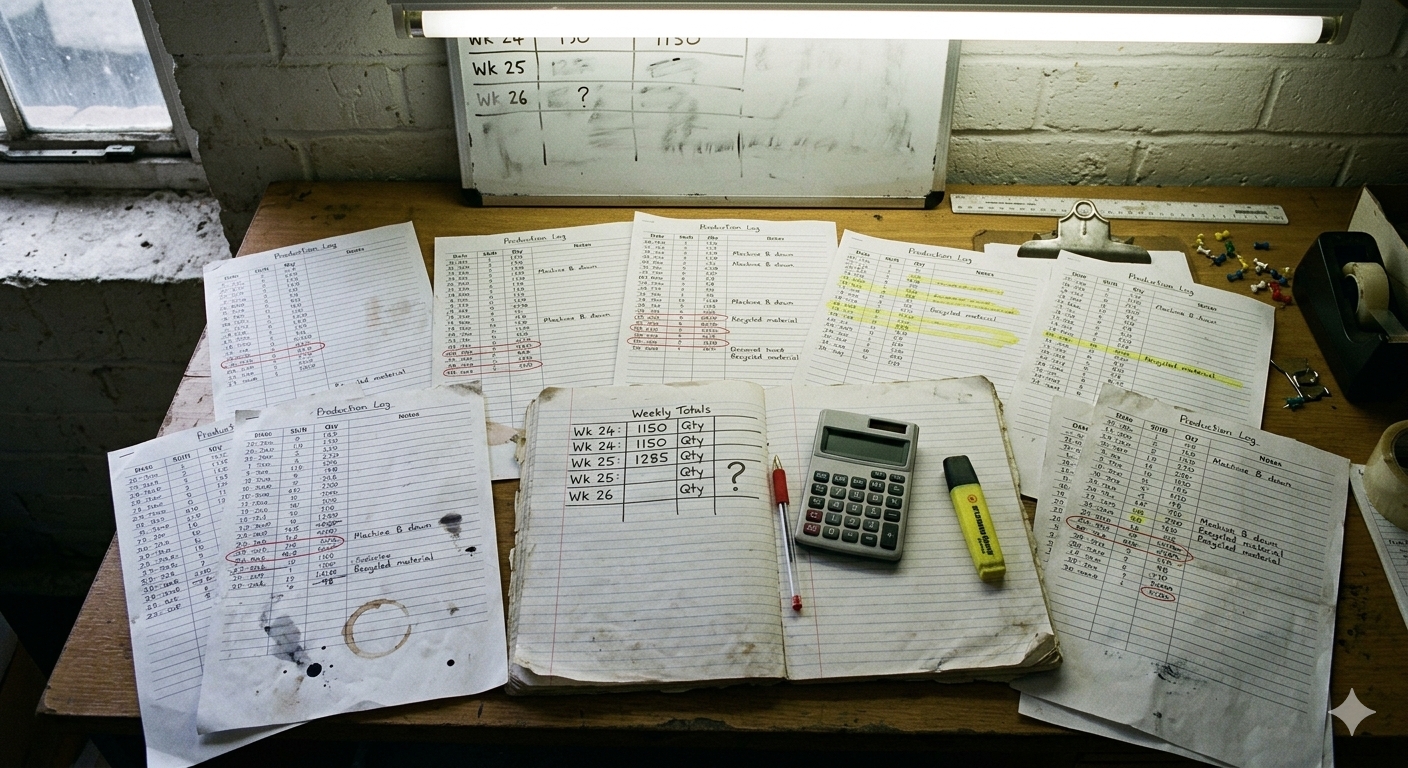
When I moved into smaller operations, that all disappeared at once. No MRP system pulling live equipment data. No historian quietly logging everything in the background. What I had instead was a mix of paper logs, whiteboard tallies that got wiped at the end of each shift, and whatever an operator remembered to write down between actually running the line.
The first time I tried to answer a simple question, what's our actual output per shift on our busiest product, I realised I didn't have an answer. Not a rough one. Not even a wrong one. There was no baseline to measure anything against, because nothing had ever been captured consistently enough to build one.
The problem with having no baseline
This is the part that surprised me most. It's not just that you can't tell if you're improving. You can't even tell if you're getting worse, until it's bad enough that everyone notices on the floor before the numbers would have told you anyway. Every decision becomes a gut call, made by whoever's been there longest, which usually gets you close enough most of the time and badly wrong occasionally, with no way to know in advance which one you're getting.
I spent weeks going through paper logs by hand, trying to reconstruct something close to a baseline. Cross referencing dates, guessing at gaps, throwing out days where the numbers clearly didn't add up. It was slow, it was rough, and it was still better than nothing, but it made me realise how much of what I'd relied on at the bigger plants wasn't actually about the plant being better run. It was about the plant having better tools to see itself clearly.
What that gap actually taught me
I don't think the answer for a smaller manufacturer is trying to recreate a full MRP and historian setup, that's not realistic for a business your size and it's not really what you need anyway. What you need is something a lot simpler, a way to capture the same basic data consistently, shift after shift, without relying on someone remembering to write it down on the right piece of paper.
That gap between what I had access to at a large plant and what I had access to at a small one is a big part of why Nexshift exists the way it does. Not to recreate enterprise complexity for a business that doesn't need it, but to make sure a smaller manufacturer can build the same kind of baseline I used to take for granted, without needing a Wonderware install or an MRP team to get there.
If you're in that position right now, trying to build a baseline out of scattered paper and memory, I've written more on what that specific transition looks like in Spreadsheets vs MES: When You've Actually Outgrown Excel.