How to Calculate OEE and Where Most Manufacturers Get It Wrong
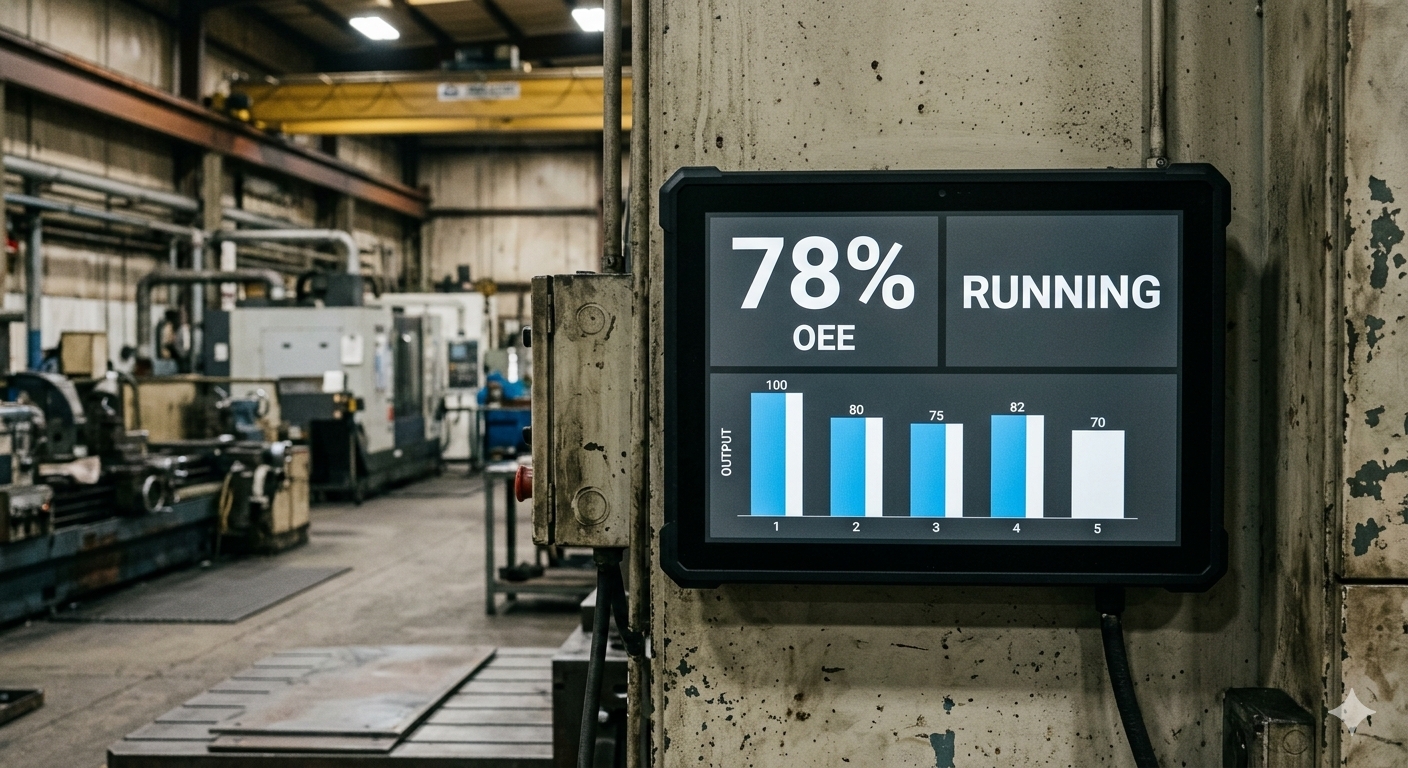
Ask most plant managers what their OEE is and they'll give you a number without blinking. Ask them how that number is actually calculated, where the inputs come from, and how confident they are in it, and the answer gets a lot less certain.
The formula everyone knows
Overall Equipment Effectiveness is Availability multiplied by Performance multiplied by Quality. Availability is how much of your scheduled time the machine was actually running. Performance is how fast it ran compared to its rated speed. Quality is how much of what came off the line was actually good.
Multiply the three together and you get a single number that's supposed to tell you how well an asset is really performing. It's a genuinely useful concept. The problem isn't the formula, it's what goes into it.
Where availability gets miscounted
Availability is usually the most honest of the three numbers, and even that gets fudged more than people realise. Short stops under a few minutes often don't get logged at all, because nobody stops to write down a two minute jam. Multiply that by a dozen times a shift and you've got a real availability hit that never makes it into the number.
Planned downtime is the other quiet distortion. Changeovers, breaks, and scheduled maintenance sometimes get excluded from the calculation entirely, which can make availability look better than what the floor is actually experiencing, and makes the number harder to trust when you compare it month to month.
Where performance gets fudged
Performance depends entirely on having an accurate rated speed for the asset in the first place, and that number is often years out of date, set once when the machine was new and never revisited. Run a machine that's been quietly derated over time against its original rated speed, and performance looks worse than the actual, current capability of that asset.
The other issue is minor speed losses. A machine running at ninety percent of rated speed because of a known but unfixed issue rarely gets flagged as a performance loss, it just becomes what everyone's used to. Over months, that's a real and repeated loss that never shows up as a distinct number anyone acts on.
Where quality gets missed entirely
Quality loss is supposed to capture rework and scrap, but it only captures what actually gets recorded as rework and scrap. Product that gets quietly reworked on the line without a formal record, or a small batch that gets binned without anyone logging why, doesn't make it into the OEE calculation at all. The number ends up looking better than the real output, because the losses that didn't get written down don't count against it.
Why the number matters less than what feeds it
A single OEE percentage is only as good as the data feeding it, and on most floors that data is a mix of what got logged manually, what got estimated, and what got missed because nobody had time to write it down mid shift. That's not a discipline problem, it's a visibility problem. Manual logging during a busy shift will always lose the small stuff, not because anyone's cutting corners, but because writing things down competes directly with actually running the line.
The plants that trust their OEE number are the ones where downtime, speed, and quality are being captured automatically as the work happens, not reconstructed afterwards from memory and a few notes. Once that's true, OEE stops being a number you're suspicious of and starts being something you can actually act on, including spotting the kind of quiet, accumulating loss that a maintenance backlog creates. I've written more on that specific pattern in Maintenance Backlogs: The Silent Killer of OEE.